
HOZO Review: Smart Precision Tools for Modern Makers, Designers, and DIY Work

HOZO positions itself in the growing space between traditional hand tools and fully digital fabrication equipment. Its catalog focuses on compact precision tools that add electronics, sensors, modular accessories, digital displays, app connectivity, or specialized motors to jobs that are usually performed with ordinary rulers, knives, levels, and sanders. The current lineup spans digital and laser measurement, ultrasonic cutting, detailed surface finishing, and modular workshop accessories. Products such as the M-Cube, NeoRuler, NeoBlade, and NeoSander show a consistent design philosophy: make repetitive or delicate workshop tasks faster while giving the user more control over accuracy. This makes HOZO especially relevant to architects, model makers, 3D-printing enthusiasts, craftspeople, interior designers, hobby builders, and technically minded DIY users who want more capability than a basic hand tool provides.
Measurement Tools Are HOZO's Strongest Foundation
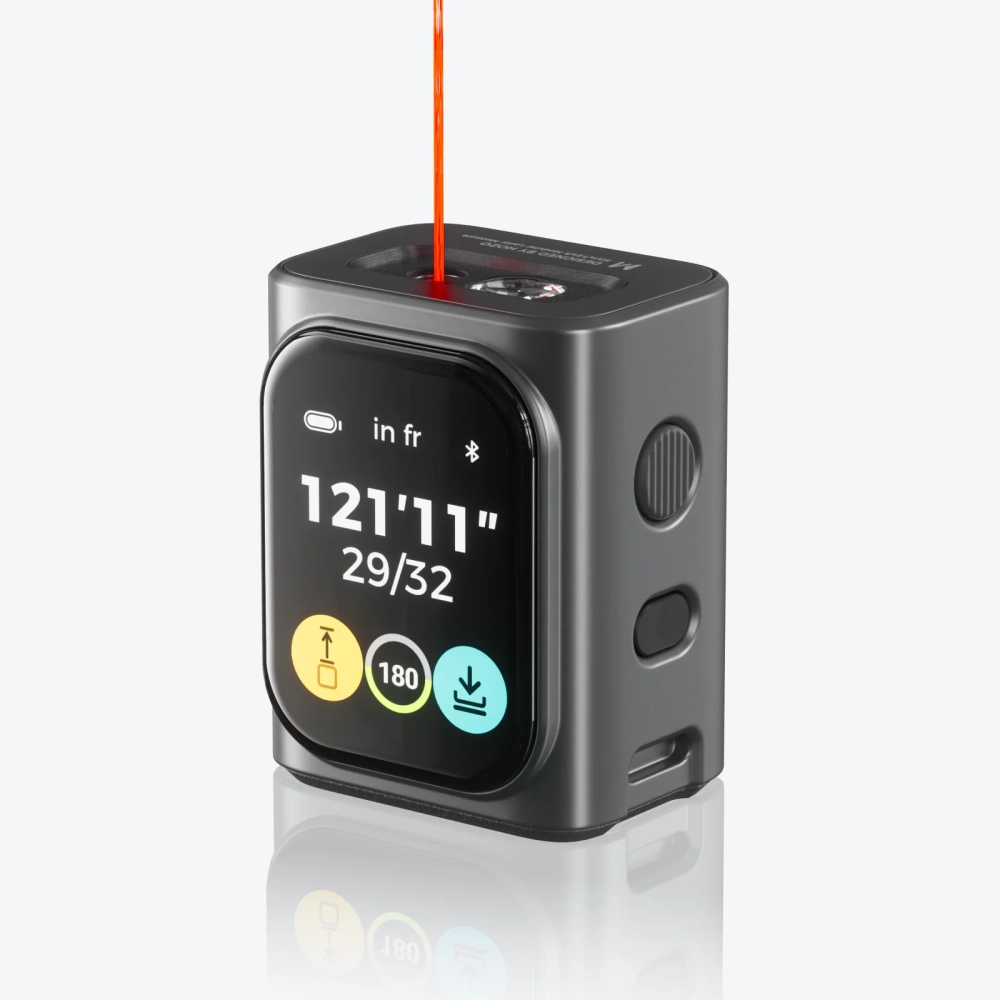
Measurement remains one of HOZO’s most developed categories. NeoRuler is a digital scale ruler designed for drawings, plans, models, and scaled layouts, with 93 built-in scales, customizable scales, multiple measurement units, a digital display, and quoted accuracy of ±0.1 mm. The M-Cube takes a different approach by acting as a modular laser measurement platform. Depending on the configuration, it can work with modules for planning, bilateral laser measurement, rolling measurement, and other tasks. HOZO also integrates some measuring products with the MEAZOR app so readings can be recorded or exported. The appeal is not simply that these tools measure distance. Their value comes from reducing manual conversion, scale interpretation, and repeated calculations, which can be useful when working from architectural plans, interior layouts, fabrication drawings, or miniature models.
NeoBlade Brings Ultrasonic Cutting Into a Portable Format
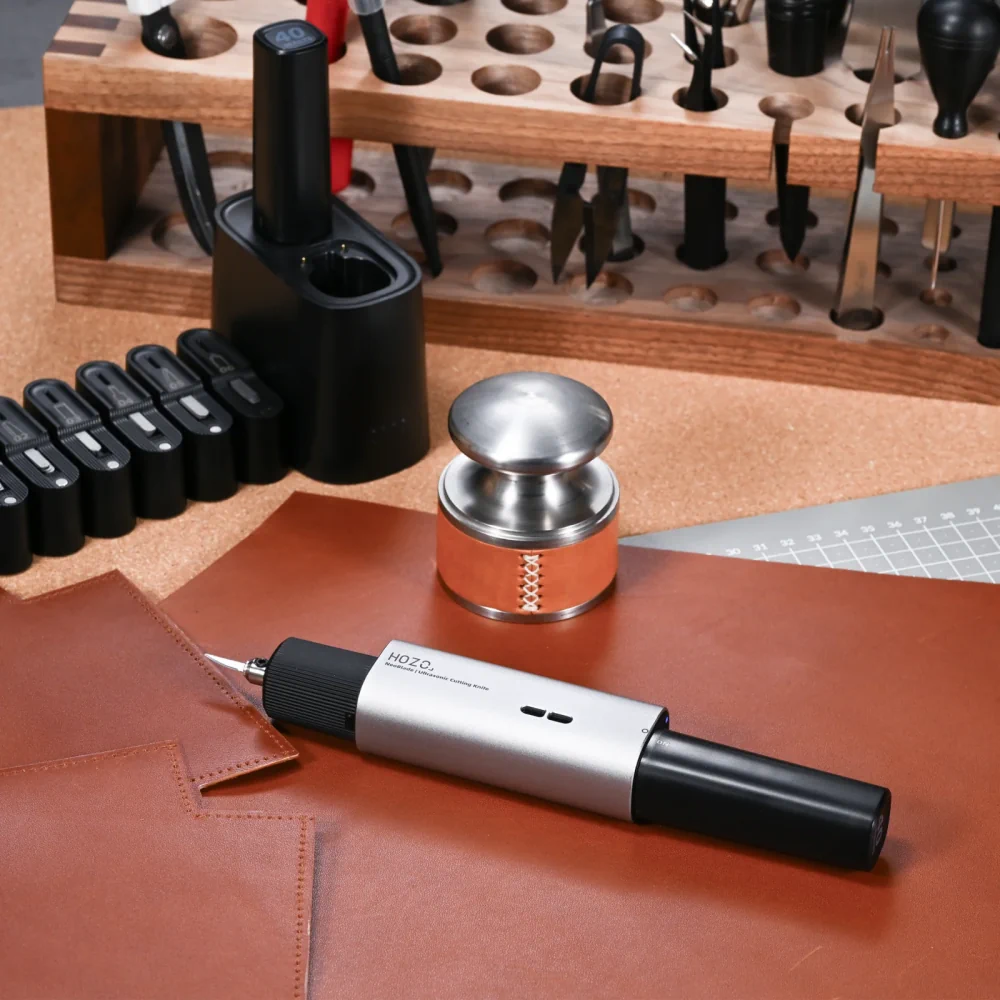
NeoBlade is one of the clearest examples of HOZO attempting to modernize a familiar workshop task. Instead of depending only on hand pressure, the cordless cutter uses a 40,000 Hz ultrasonic transducer and adaptive output rated from 9W to 40W. HOZO pairs that system with active cooling, replaceable battery packs, USB-C or dock charging, and several blade profiles for straight cutting, carving, grooves, curves, and detail work. The practical advantage is precision. Materials that are tiring or awkward to cut by hand can be approached with less physical force, particularly when the job involves small parts or repeated cuts. However, this is still a specialized tool rather than a universal replacement for knives, saws, or rotary cutters. Its strongest use case is controlled craft and fabrication work where clean, deliberate cuts matter more than brute cutting capacity.
NeoSander Targets Detailed Finishing and 3D Print Cleanup
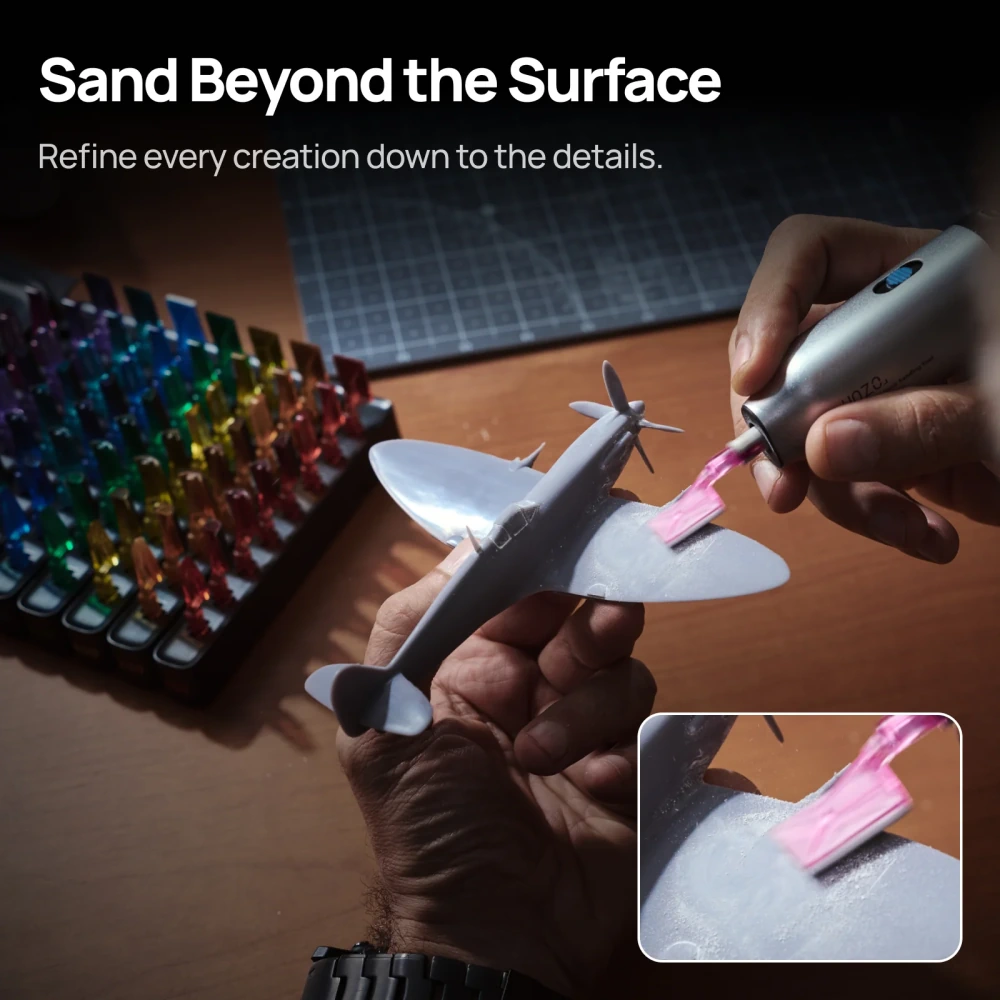
NeoSander extends HOZO’s precision-first philosophy into finishing. It is a compact cordless reciprocating detail sander designed for resin, PLA, ABS, wood, metal, automotive paint, and powder-coated surfaces. HOZO lists a weight of 89 grams without a sanding head, adjustable operation, eight interchangeable head shapes, and sanding media ranging from coarse to fine grits. The reciprocating action is particularly suited to corners, grooves, edges, and small curved surfaces where conventional orbital sanders or rotary tools may remove too much material or become difficult to control. This gives NeoSander a strong niche in model making and 3D-print post-processing, where removing layer lines, support marks, and small imperfections often requires patience. Its modular head system also makes the tool more versatile than a single-purpose detail sander.
Design, Modularity, and Usability
HOZO products are visually consistent and generally built around compact forms, clear displays, interchangeable modules, accessory ecosystems, and rechargeable power. The M-Cube is a strong example because the core unit can be paired with several measurement modules rather than requiring a completely separate device for each task. NeoRuler also expands through add-ons such as caliper, drafting, reading, and storage accessories. NeoBlade offers multiple blade shapes, charging accessories, replaceable batteries, and dedicated work surfaces, while NeoSander uses interchangeable sanding heads and optional saw attachments. This ecosystem approach can be efficient for committed users because accessories extend the usefulness of a base tool. The tradeoff is that getting the most from the system can encourage additional purchases. For buyers who only need one simple task performed occasionally, a conventional tool may remain the more economical choice.
Performance, Precision, and the Learning Curve
HOZO’s strongest selling point is not raw power. It is controlled precision combined with convenience. Digital readouts, built-in scales, laser measurement, modular heads, ultrasonic cutting, and compact reciprocating sanding are all designed to reduce small errors and make delicate work more repeatable. That said, advanced tools still depend on correct technique. A digital ruler does not replace careful alignment, a laser tool still requires a stable reference, an ultrasonic cutter requires material awareness and blade discipline, and a detail sander can still change the shape of a workpiece if used aggressively. New users should expect a short learning period, particularly when moving from ordinary manual tools. HOZO’s products are therefore best viewed as productivity and accuracy aids. They can improve workflow, but they do not eliminate the need for craftsmanship, careful setup, or sound judgment.
Pricing, Warranty, and Overall Value
HOZO occupies a premium position compared with basic manual tools, although prices vary widely by product and configuration. The official store currently lists entry-level products such as the M-Cube main unit at a substantially lower price than complete modular kits, while more comprehensive systems can cost several hundred dollars. NeoRuler, NeoBlade, and NeoSander also become more expensive when purchased with broader accessory packages. In return, HOZO emphasizes integrated features, rechargeable operation, modularity, and specialized functions that are uncommon in inexpensive tools. The company currently advertises international shipping, a one-year limited warranty, and 14-day hassle-free returns on eligible purchases. Value therefore depends heavily on how often the advanced functions will be used. Professionals and frequent makers may justify the premium more easily than occasional household users who need only basic measuring, cutting, or sanding.
Pros and Cons of HOZO Tools
Pros
Cons
Final Verdict: Who Should Consider HOZO?
HOZO is most compelling for makers who care about accuracy, repeatability, portability, and fine control. Its tools are not simply electronic versions of familiar workshop equipment. The better products add capabilities that are difficult to reproduce with basic tools, such as instant scale conversion, modular laser measurement, ultrasonic cutting, or highly controlled reciprocating sanding. That gives the brand a credible place in studios, workshops, model-making benches, architecture desks, fabrication spaces, and serious hobby setups. The premium pricing means HOZO will not be the obvious choice for every buyer, especially when a standard ruler, knife, level, or sander is already sufficient. For users whose projects depend on precise measurements and detailed finishing, however, the combination of smart features, specialized accessories, and compact engineering makes HOZO a distinctive and technically interesting tool brand.